For outpatient imaging networks, imaging data is one of the most valuable assets they generate.
Every day, imaging centers produce data across modalities, body regions, pathologies, and patient populations. These studies are essential for clinical care, but they can also help address one of the biggest barriers in medical AI development: access to representative, high-quality medical data.
The challenge is that most outpatient imaging networks do not have the time, infrastructure, or internal bandwidth to turn that data into a useful, secure, and commercially viable resource for AI developers.
This case study explains how one large US outpatient imaging network worked with Gradient Health to create a data partnership built around secure transfer, de-identification, and ongoing revenue share.
The partner remains anonymous, but the process reflects what other outpatient imaging networks can expect when exploring a data partnership with Gradient.
The imaging network had a large archive of historical imaging studies and associated radiology reports across multiple modalities, including X-ray, CT, DXA, mammography, MRI, PET, and ultrasound.
Like many outpatient imaging organizations, the network recognized that its data had potential value beyond its original clinical use. Medical AI developers need diverse, real-world imaging data to train, test, and evaluate their technologies. Outpatient imaging networks are well placed to support that need because they often serve large and varied patient populations across multiple locations and imaging workflows.
However, recognizing the opportunity and being able to act on it are not the same thing.
The network had previously explored ways to use its data commercially, but the process had not moved forward. The barriers were familiar: commercial uncertainty, technical complexity, privacy considerations, and questions about how much work would fall on the internal team.
Gradient’s role was to make the process practical.
The goal was to build a long-term partnership that allowed the imaging network to generate ongoing value from de-identified imaging data while supporting the development of better medical AI.
From the outset, the partnership was designed as a long-term relationship.
The first stage involved a multi-million-study historical data delivery, split into phases to make the process easier to manage. This gave both organizations a clear structure for transfer, processing, validation, and onboarding into Atlas, Gradient’s data platform for medical AI developers.
The partnership also included ongoing ingestion of new studies allowing the network to keep adding value over time without having to restart the partnership from scratch or find capacity for more batch transfers.
For the imaging network, this created a route to a new recurring revenue stream. For Gradient, it added valuable real-world outpatient imaging data to support AI developers working across a wide range of clinical use cases.
A core requirement for the partner was confidence in how the data would be handled.
Gradient managed the process through a structured workflow designed to reduce operational burden for the imaging network while maintaining strong safeguards around privacy and data quality.
The process included:
The first phase began, following due diligence and contracting, with a secure transfer process for the initial batch of historical studies. Gradient provided the required technical infrastructure and worked with the partner to move the data into a controlled cloud environment.
Once received, the data was processed so that imaging studies could be linked with their associated radiology reports.
This is a critical step for medical AI development. Images alone are useful, but images connected to reports provide richer clinical context. For AI developers building and evaluating models, that context can make the data significantly more useful.
After ingestion and linking, the data went through Gradient Health’s de-identification process.
For outpatient imaging networks, this is one of the most important elements of any data partnership. The data needs to be useful for AI development, but it also needs to be handled responsibly, with appropriate safeguards before it is made available to developers. Gradient employ industry leading de-identification processes that comply with relevant laws including HIPAA.
The partner requested an additional validation step before the data became available through Atlas.
After de-identification, Gradient shared sample studies back with the partner for review. This gave the data partner an opportunity to check the output and built confidence that the data had been appropriately processed before being made available.
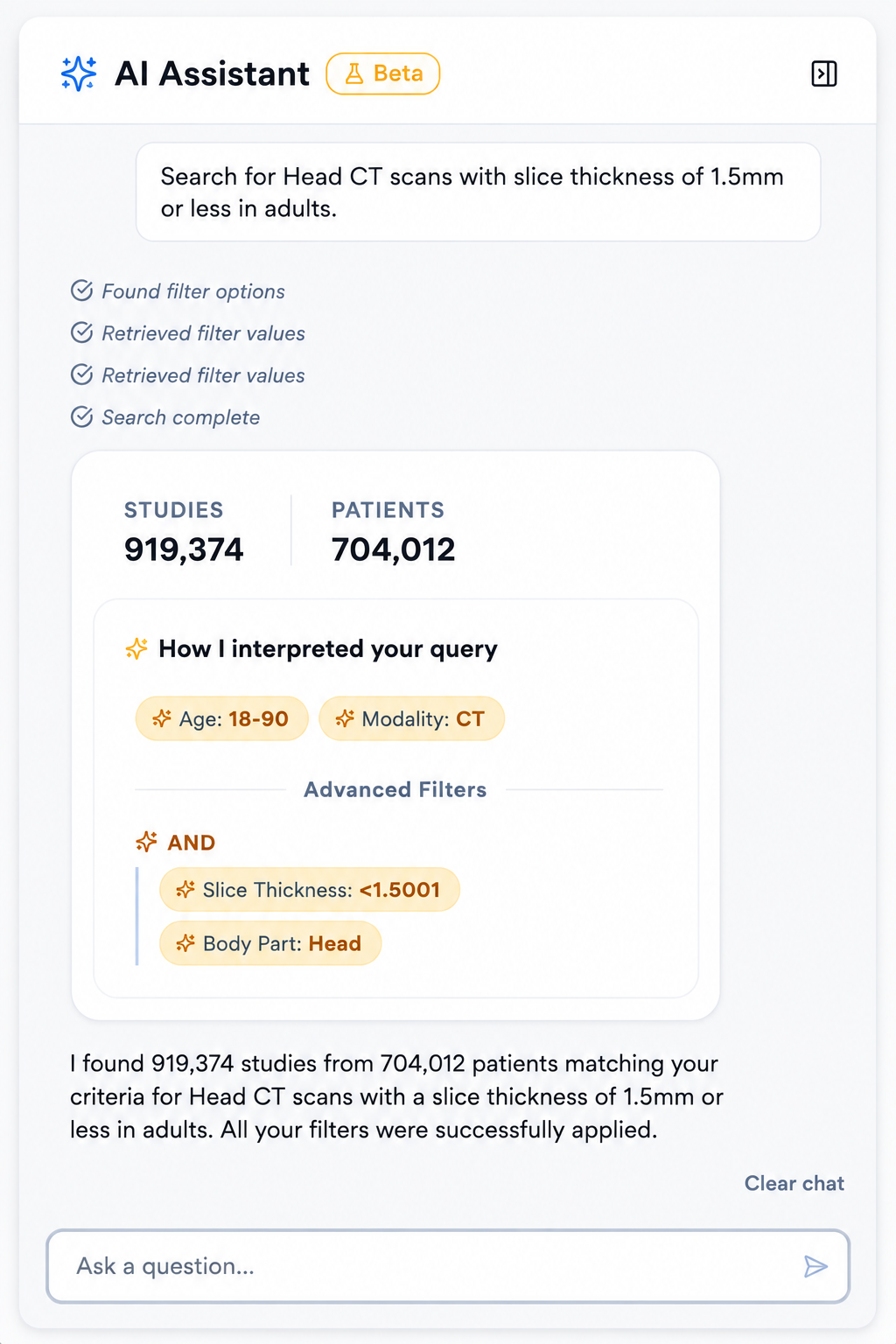
Once processing, de-identification, and validation were complete, the data could be made available through Atlas for approved medical AI development use cases.
The partner also received access to Atlas for internal research and visibility purposes. This allowed the organization to understand how its data was represented while maintaining appropriate controls.
The partnership was built around a revenue share model.
When the data is commercialized through Gradient Health, the imaging network receives a share of the revenue. The agreement also included incentives tied to the amount of data shared, encouraging the partner to expand from an initial delivery to a larger, more valuable dataset over time.
This approach helped align both organizations.
For the imaging network, there was a clear commercial reason to participate. The partnership created a way to generate value from existing data without creating a major new operational burden.
For Gradient Health and its AI developer customers, the model supported access to larger, more diverse, and more clinically useful datasets.
Key outcomes included:
This case study highlights several practical lessons for outpatient imaging leaders considering a data partnership.
First, the commercial model is crucial, a revenue share structure helps create long-term alignment between the imaging network and the data partner.
Second, the process needs to be low burden. Ongoing ingestion creates more value than a one-time archive transfer. A data partnership becomes more valuable when it can grow over time.
Third, de-identification and validation are essential. Partners need confidence that data is handled responsibly before it is made available.
Finally, outpatient imaging networks have an important role to play in the future of medical AI. Their data can help developers build tools that are more representative of real clinical environments, not just narrow academic datasets.
Learn how your organization can create value from de-identified data while supporting the development of medical AI.