From isolated algorithms to workflow-aware clinical AI systems
Medical AI is moving to a new era of maturity.
We've moved from the early days, where developers needed to prove that an algorithm could detect findings in curated test datasets, to a point where they are increasingly being judged on whether their systems generalize across healthcare settings, integrate into clinical workflows, and support safe, repeatable use at scale.
At the same time, foundation models are changing how medical AI is developed. Instead of building every application from the ground up, developers can pretrain models on large datasets and adapt the results for multiple downstream tasks.
This creates significant opportunities, but it also changes what developers need from their data infrastructure.
What is a medical foundation model?
A foundation model is a large, pretrained AI model designed to learn reusable patterns from broad datasets. It can then be adapted to specific downstream applications through techniques such as fine-tuning, prompting or other forms of model adaptation.
Taking medical imaging as an example, a foundation model might learn general representations of anatomy, pathology, imaging characteristics, and relationships between images and clinical text. Those representations could subsequently support applications such as detection, segmentation, classification, report generation, risk prediction, or patient prioritization.
This is different from many existing clinical AI products, which are developed and authorized for one narrowly defined task.
It is also important to distinguish foundation models from multimodal models. A foundation model is defined primarily by the scale and adaptability of its pretraining. A multimodal model combines multiple forms of information, such as imaging, clinical reports, laboratory results, pathology, ECG, or EHR data. A given medical AI model could be one, both, or neither.
Medical AI is moving beyond isolated point solutions
Many clinically implemented AI products answer a specific question within a particular workflow. They might prioritize scans with a suspected acute finding, segment a tumour, quantify a biomarker, or identify patients who may require further review.
These products have demonstrated the value of AI in medicine, but a portfolio of separate point solutions can create operational challenges. Healthcare organizations may need to manage multiple integrations, contracts, user interfaces, validation processes, and monitoring requirements.
Foundation models offer a different development architecture. A reusable model backbone could support several related applications without requiring every model to learn fundamental medical representations independently.
That could accelerate experimentation, reduce duplicated development work, and improve the transfer of learned representations between tasks.
However, a shared foundation model does not automatically become a single, integrated clinical product. Each intended use will still require its own validation, risk controls, regulatory evidence, workflow design, and performance monitoring.
The model architecture is only one part of the clinical system.
Foundation models change the scale of the data problem
Foundation models can learn from large volumes of labeled, weakly labeled, paired, and unlabeled data. This can reduce dependence on fully annotated datasets during pretraining, but it does not reduce the need for quality data overall.
In many cases, it increases it.
As dataset size grows, data quality problems also become more consequential. Duplicated records, inconsistent metadata, incorrectly linked reports, site-specific artifacts, demographic imbalance, and undocumented acquisition differences can all become patterns that the model learns.
Even at foundation-model scale, volume does not compensate for weak provenance or limited clinical diversity.
Developers need to understand:
This makes data curation, documentation, and governance core model-development concerns.
Multimodal data can provide the clinical context models are missing
Clinicians rarely make decisions from a single exam or test result in isolation. They combine information from the patient’s history, previous imaging, laboratory results, pathology, symptoms, treatments, and changes over time. Multimodal AI attempts to give models access to more of that context.
Depending on the use case, this might involve combining:
This can help models learn relationships that are not visible within one modality alone. Imaging findings may become more interpretable when paired with laboratory data, while longitudinal records can help distinguish a transient abnormality from a progressive pattern. However, more data types do not automatically produce a better model.
The modalities must be clinically relevant, correctly linked, and aligned to the appropriate point in the patient journey. Developers also need to account for real-world missingness. Not every patient receives every test, and the presence or absence of a data type may itself reflect clinical decisions, access patterns, or disease severity.
The objective should be to create an accurate and usable representation of the clinical context required for the intended task.
Data sourcing becomes an infrastructure challenge
No individual healthcare organization holds enough representative data to support every foundation-model or multimodal development program. Developers need data spanning multiple institutions, geographies, patient populations, hardware manufacturers, imaging protocols, care settings, and clinical specialties.
That creates substantial operational complexity.
Every additional source can introduce different contractual requirements, privacy frameworks, de-identification processes, coding standards, security controls, and permitted-use restrictions.
Multimodal projects add another layer. Imaging, reports, laboratory systems, pathology platforms, and EHR records are often stored separately. Linking them can require patient-level matching, temporal alignment, terminology normalization, and detailed quality assurance.
Harnessing data at this scale is therefore not just a procurement process, it becomes an infrastructural requirement.
The next phase of medical AI will be data-intensive
Medical AI is moving from isolated technical demonstrations toward systems that can operate across tasks, institutions, and clinical workflows.
Foundation models and multimodal AI could accelerate that transition by enabling more reusable representations and richer models of the patient journey. They could also support research applications such as biomarker discovery, cohort identification, and clinical-trial recruitment, but their success will depend on more than model scale.
The organizations that make meaningful progress will be those that can source, link, govern, document, and curate clinically relevant data across diverse real-world populations.
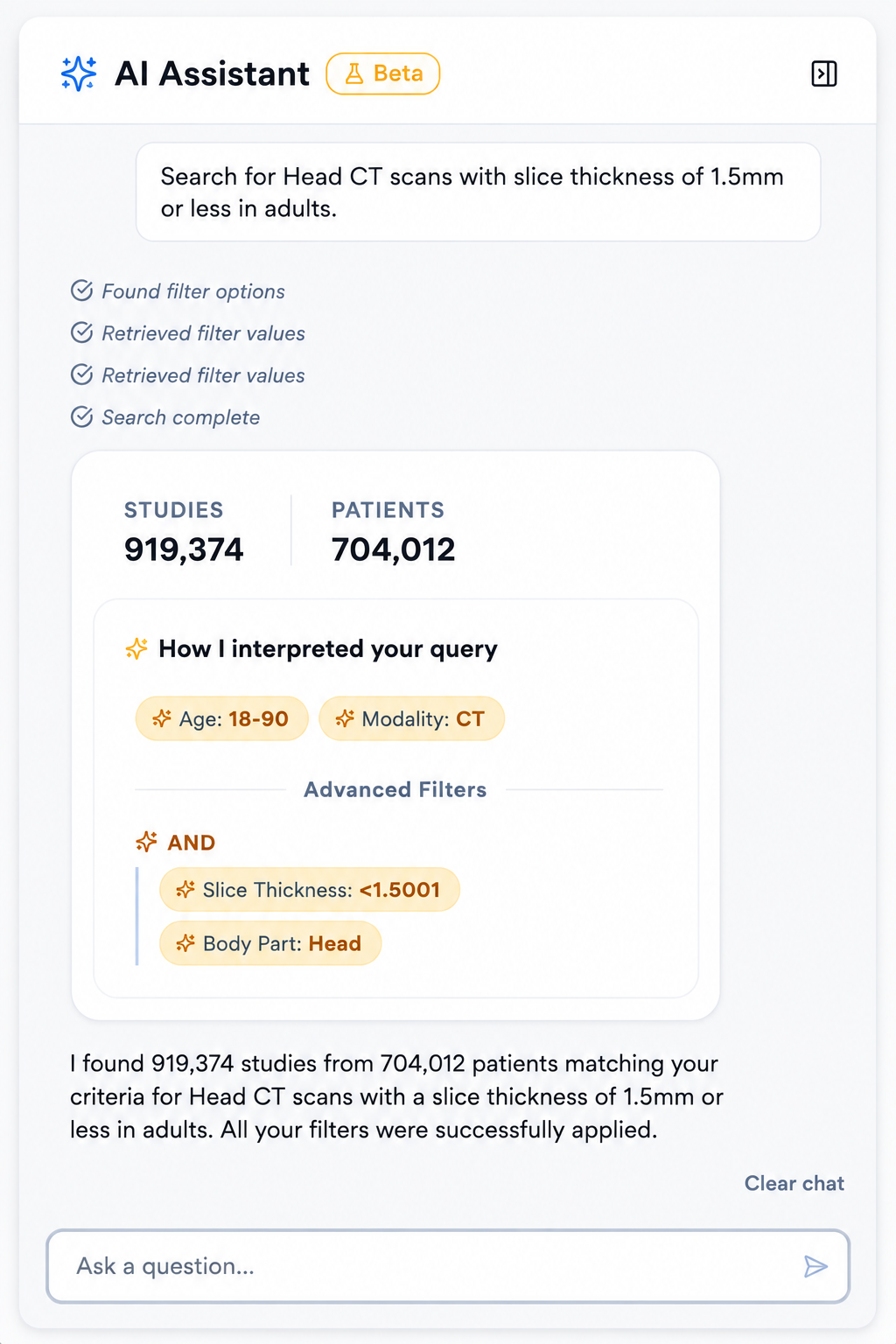
Gradient Health supports medical AI developers with access to more than 20 million medical imaging studies through Atlas. We are expanding that infrastructure to support additional data types, including EHR, pathology, laboratory, and ECG data, helping teams develop and evaluate the next generation of multimodal medical AI.
Frequently asked questions
Do foundation models replace task-specific medical AI?
Not necessarily. A foundation model usually provides a reusable pretrained backbone. Developers can adapt that backbone into task-specific systems, each of which may still require separate clinical validation, integration, and regulatory evidence.
Why do medical foundation models require so much data?
Foundation models learn broad, reusable representations rather than optimizing only for one predefined task. This generally requires large datasets covering sufficient clinical, demographic, technical, and geographic variation.
What is multimodal healthcare data?
Multimodal healthcare data combines two or more forms of medical information, such as imaging, clinical reports, EHR records, laboratory values, pathology, ECG, genomics, or longitudinal outcomes.
What makes multimodal healthcare data difficult to use?
The data is often distributed across separate systems and represented in different formats. It must be de-identified, standardized, correctly linked at patient level, temporally aligned, quality checked, and governed under appropriate usage agreements.