Building on more than 20 million existing studies, Gradient Health is adding new data capabilities including EHR, pathology, labs, and ECG to support the next generation of medical AI.
DURHAM, N.C. and AMSTERDAM, Netherlands, June 15, 2026: Gradient Health, a leading healthcare data platform for medical AI development, today announced the expansion beyond imaging to support multimodal healthcare data.
The announcement, made on the opening day of HLTH.Europe in Amsterdam, marks a major expansion of Gradient Health’s role in the medical AI ecosystem. Already trusted by more than 200 medical AI companies, from early creation through testing, evaluation, and regulatory submissions, Gradient Health is now extending Atlas to help developers access richer, more contextual data for building, evaluating, and validating medical AI models.
Atlas currently gives AI developers access to more than 20 million medical imaging studies, including radiology reports and longitudinal datasets that can show the same patient’s scans across multiple time points. With this expansion, Gradient Health is adding support for additional data types, including EHR data, pathology results, and cardiac data such as ECG.
These new data types will be introduced progressively through Atlas, with the goal to give AI developers a scalable, responsible, and searchable infrastructure for accessing multimodal healthcare data as availability grows.
The expansion reflects a broader shift in medical AI as the field moves from narrow single-point solutions toward broader foundation models and more advanced clinical AI systems, developers increasingly need access to data that reflects the complexity of real-world care. Imaging remains essential, but many clinically valuable AI applications require additional context, including clinical notes, patient history, laboratory data, pathology results, and other structured or unstructured clinical information.
Gradient Health’s multimodal expansion is designed to support that transition.
“Imaging is already one of the strongest applications for medical AI,” said Pranav Rajpurkar, PhD, Associate Professor at Harvard Medical School and Co-Founder of a2z Radiology AI. “By adding multimodal context, Gradient can help developers build more useful, representative, and generalizable systems, while addressing one of the field’s biggest data access challenges.”
“Medical AI is moving fast, but the next generation of models will only be as good as the data behind them,” said Josh Miller, CEO of Gradient Health. “Imaging has been our foundation, and it remains central to what we do, but healthcare is multimodal by nature, a scan rarely tells the whole story on its own. By expanding Atlas to support multimodal data, we are helping AI developers build systems with richer clinical context, while giving healthcare organizations a secure and responsible way to contribute to innovation. Better data means better AI, and better AI should mean better access to advanced care for more patients.”
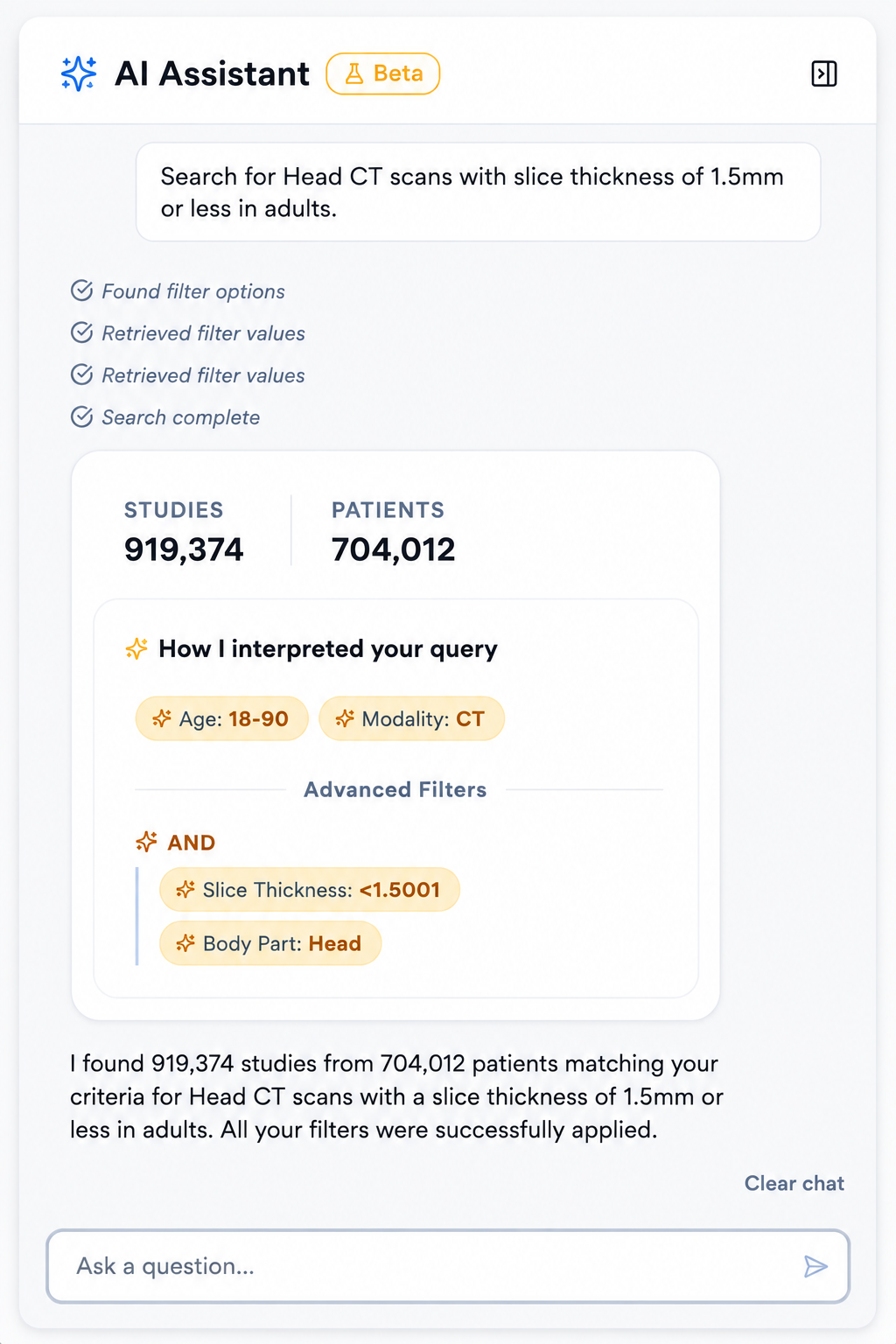
Gradient Health’s existing imaging infrastructure already supports a wide range of AI development use cases, including model training, testing and evaluation, regulatory submissions, and foundation model development. The addition of multimodal data will also improve search and cohort-building for imaging use cases, helping developers identify more clinically relevant datasets by combining imaging findings with other contextual signals.
For example, developers will now be able to search and build cohorts not only by modality, anatomy, or radiology report terms, but also by relevant clinical context, laboratory values, pathology markers, demographics, or other available data fields. This can help AI teams move faster, reduce data sourcing friction, and build models that better reflect real-world populations and care pathways.
Gradient Health’s expansion also creates a larger opportunity for healthcare data partners. By working with Gradient Health, healthcare organizations can generate value from de-identified data assets while contributing to the development of more representative and clinically useful AI. The company’s global data partner network gives AI developers access to more diverse datasets, helping reduce the risk of building models that perform well in one setting but fail to generalize across different populations, systems, and geographies.
Gradient Health will be discussing its multimodal data expansion at HLTH.Europe in Amsterdam from June 15 to 18, 2026.
To meet with Gradient Health at HLTH.Europe or learn more about multimodal data access through Atlas, visit GradientHealth.io
What is Gradient Health announcing?
Gradient is expanding Atlas beyond medical imaging to support multimodal healthcare data. This means AI developers will be able to access richer datasets that combine imaging with additional clinical information, including EHR data, pathology, laboratory results, demographics, ophthalmology, ECG data, and other available data types over time.
What data does Gradient Health already offer?
Gradient currently provides access to more than 20 million medical imaging studies through the Atlas platform. These studies include radiology reports, and many datasets are longitudinal, meaning developers can identify scans from the same patient across multiple time points where available.
What new data types will Atlas support?
Atlas will support additional data types including EHR data, pathology, laboratory results, demographics, ophthalmology, and ECG data. Availability will vary by data type, geography, and use case.
Why does multimodal data matter for medical AI?
Healthcare is inherently multimodal. Clinicians do not make decisions based on imaging alone. They combine scans with reports, laboratory results, pathology findings, demographics, patient history, and other clinical information. Multimodal data can help AI developers build more clinically relevant models that better reflect real-world care.
How does this help imaging AI developers?
The expansion improves search and cohort-building even for imaging-only use cases. Developers can identify more relevant imaging datasets by using additional clinical context, such as diagnosis codes, laboratory values, pathology data, demographics, or other available data fields.
Who uses Gradient Health?
Gradient already supports more than 200 medical AI companies, from early-stage model creation through testing, evaluation, and FDA submissions. The company has also supported foundation model development.
How does this benefit healthcare data partners?
Healthcare data partners can work with Gradient to generate value from de-identified data assets while contributing to the development of more representative and clinically useful AI. The expansion into multimodal data broadens the types of data that partners can make available responsibly through Atlas.
How does Gradient Health protect privacy?
Gradient is built around responsible access to de-identified healthcare data. The company is certified for its de-identification techniques and supports HIPAA requirements, SOC 2 controls, and has strong governance processes for healthcare data access and partnership.
Gradient Health helps medical AI developers access the diverse, de-identified healthcare data they need to build, evaluate, validate, and deploy clinical AI. Through Atlas, its healthcare data platform, Gradient provides access to more than 20 million medical imaging studies, radiology reports, and longitudinal datasets.
Gradient Health works with more than 200 medical AI companies and a global network of healthcare data partners to make representative, responsibly sourced healthcare data more accessible. With the expansion of Atlas to support multimodal data, Gradient Health is helping build the data infrastructure needed for the next generation of medical AI.
Media Contact
James Hounsell, Evolene Ltd.